
 Battlefield casualties
- Fulford is arguably the battle that made the Norman Conquest possible, although it has largely been overshadowed by the battles of Stamford Bridge and Hastings. Over the last years a considerable amount of work has been done to try and identify the site of the battle. On Saturday 21st September Medieval Section members visited Fulford for a tour of what is very probably the site of the 1066 battle. Our guide, Chas Jones, is careful to point out that it is the evidence that points to Fulford as the site of the battle, not him, and English Heritage are unambiguous in saying that this is the likely location.

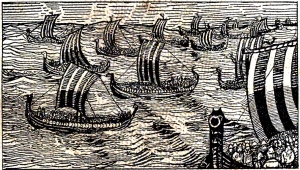
- Scandinavian fleet (from Chas Jones The Forgotten Battle of 1066 Fulford)

The historical context for the battle is as follows. In the summer of 1065 the Northumbrians rebelled against the unpopular rule of Tostig. Having lost control of northern England Tostig appealed to his brother Harold Godwinson of England to reinstate him but when Harold refused, Tostig sought help from abroad. In September 1066 whilst Harold was waiting for the Normans to land on the south coast, Tostig and Harald Hadrada of Norway landed in East Yorkshire and sacked Scarborough. They sailed up the Humber with a large fleet, exploiting high tides to land at Riccall about 3.5 miles from Fulford. Tidal rises of between 7 and 11m have been recorded which would have helped the Scandinavians. In the Domesday Survey Tostig is recorded as the owner of the manor and 25(?) hides at Fouleforde, and so he must have been familiar with the phenomenon of high tides at this time of year. Earls Morcar and Edwin moved their forces to cover the likely invasion routes on the rivers Wharfe and Ouse. The Northumbrian army marched out from York to meet the invaders. Chas points out that all of the experts who have looked at the evidence (e.g. the English Heritage Battlefields Panel) say that Germany Beck is the’ probable/most likely place’ for the battle. A plaque in the playing field commemorates what an earlier generation of researchers thought to be the site, very close to where Chas and other reserachers also believe the battle took place.

- Commemorative plaque for the battle of Fulford

Sources for the battle are sketchy at best but Chas has drawn on material from Scandinavian sagas and related it to the topography at Fulford. Though written down in the 13th century there are grounds to suppose that the composer was concerned to record historical information accurately.

- Chas Jones

Having set out the historical context for the battle, Chas explained the topography at Fulford, which is crucial to understanding the battle. The glacial moraine on which the village now stands is key. It overlooks low-lying swampy ground and there are steep slopes on either side, so that the defending force would have its flanks protected. In addition the watercourse, Germany Beck, would have served as a moat, protecting the approach to York from the south along the moraine.

- the slope down to the Germany Beck

Chas drew on the Icelandic Saga written by Snorri Sturluson after 1220 to give us an account of the battle. An excerpt appears in Joan Pickering and Irene Briddon’s A History of Fulford, a copy of which can be found in the Yorkshire Archaeological Society library at Claremont:-
Harold (Hadrada) began to array his men. One wing stood upon the river bank, and the other higher up, near ditch, which was deep and broad and full of water. The jarls (Jorvik men) let their arrays go down along the river and most of their men in line. The standard of Harald was near the river, there the ranks were thick, but they were thickest at the ditch, and least to be depended upon. Thither Morkere came down with his standard. The wing of the Northmen by the ditch retreated, and the English followed them, thinking they were going to flee, but when Harald saw that his men retired along the ditch, he ordered a war-blast to be blown and urged them on. He had the standard ‘Landwaster’ carried forward, and made so hard an attack that all were driven back. There was great slaughter in the Jarl’s host. Walthof (Morkere’s brother) had had his standard brought along the river, downward against the army of Harald, but when the king hardened the attack, the Jarl and his men fled along the river upward. Only those who followed him escaped, but so many had fallen that large streams of blood in many places flowed over the plain. When the Jarl had fled, Harald surround Morkere and the men who had advanced along the ditch with him. The English fell by hundreds. Many jumped into the ditch and the slain lay there so thick that the Norsemen walked across it with dry feet on human bodies. there Morkere perished.
This is a slightly looser excerpt from the Heimskringla or The Chronicle of the Kings of Norway (Saga of Harald Hardrade sections 87 & 88).
What seems to have happened is that Tostig’s forces tried to cross the Germany Beck but were thrown back by Morcar and the Northumbrians. However, the Northumbrians were then taken in flank by Hadrada’s Scandinavians who, having pushed back Edwin’s men along the river bank, had been waiting for their moment in low-lying ‘dead’ ground close to the River Ouse. Perhaps the falling tide allowed them to cross the Germany Beck which had earlier proved too great an obstacle. A scene in the Fulford Tapestry sewn in the style of the Bayeux tapestry shows the battle. The Northumbrians fled along the Germany Beck to escape encirclement and Chas told us about archaeological work in the area immediately north of the battlefield which has revealed hearths and furnace bottoms where broken arms and armour were recycled. Chas showed us the centre of the battlefield on the moraine, the Germany Beck and the ‘dead’ ground near the river from which the Scandinavians attacked. Walking back to the village it was striking just how steep the edge of the moraine is.

- edge of moraine

Over a number of years Chas has sampled various areas of the battlefield looking for evidence. He thinks he may well have this confirmatory evidence but unfortunately he couldn’t show us any military finds when we visited because the objects are in the York conservation lab. However, he did say that iron nails and furnace bottoms found along the supposed line of the Northumbrian retreat have excited considerable interest amongst Scandinavian archaeologists.
A short time after the battle King Harold arrived, having marched the length of England at great speed. He caught Hadrada, Tostig and part of their army by surprise at Stamford Bridge on 25th September. Orders were sent back to the fleet at Riccall for reinforcements but the Scandinavians suffered heavy casualties. It was said that only a small fraction of the original invasion fleet returned to Norway. Having learnt that William of Normandy had landed, Harold returned south. His men were tired after their epic march and not all of the reinforcements had arrived. At Hastings on 14th October Harold was killed with many of his closest supporters and William I became king of England.
Sadly the site of the battlefield is threatened by development – a housing estate and a road – surprisingly located on low-lying ground liable to flooding. Chas has challenged the development in the courts but the battlefield is still under threat. For trowelling opportunties in advance of development see http://www.medieval.yas.org.uk/bl0g/?p=218
One of the suggestions that came out of this our first meeting of the new Medieval Section programme for 2013-14 was that we hold a dayschool looking at Yorkshire and Yorkshire related Medieval battlefield archaeology. Chas’ talk at Fulford certainly gets us off to a good start if this is something members would seriously like the Committee to explore. Any thoughts?


 Medieval Section of the Yorkshire Archaeological and Historical Society